Redacted document leaked before service on Reform UK Party Limited / Nigel Farage
At about 10:30 BST, I completed the online submission of the [redacted document] against Reform UK Party Limited.
At 10:44 BST, I received an email from the court telling me the filing had been approved with case number [redacted]. The email asked for somebody to call the court and confirm a deposit for the Official Receiver, in the case the debtor has no assets at all to cover the cost of the process.
At 10:56 the payment was processed.
At 11:14 the court sent me a copy of the [redacted document] against Reform UK Party Limited with the court's seal on it.
A few minutes later, I forwarded the official version of the [redacted document] to a process server.
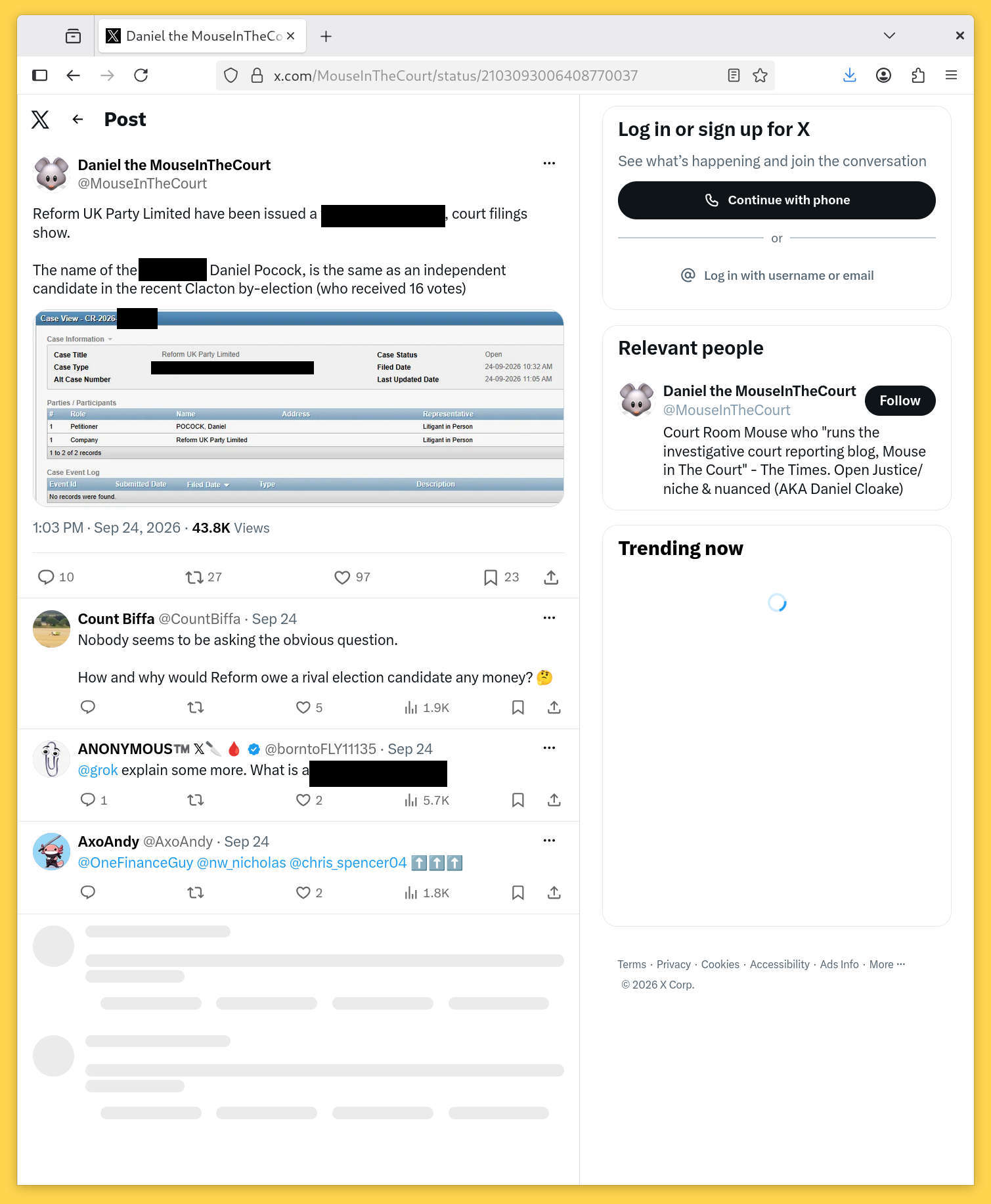
At 13:03, a post appeared in the social control media account for the MouseInTheCourt web site. Direct link to Twitter/X post.
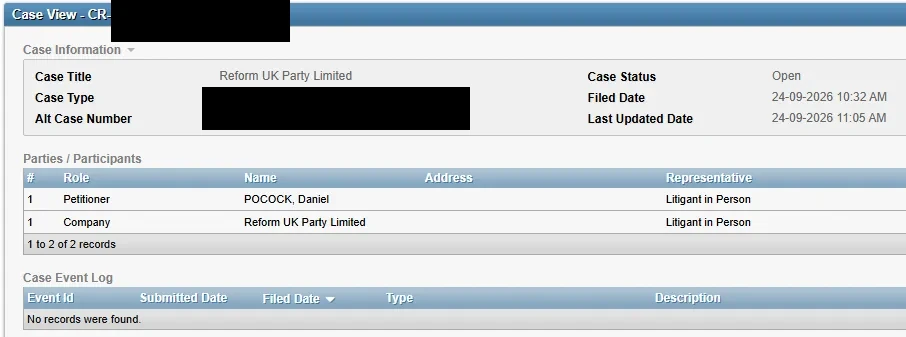
The social media post includes a "Case View" screenshot from the court management web site.
Here is a screenshot of the social media post and a copy of the image shared in the post:
At 13:30 the documents were formally served at the registered office of Reform.
At 14:03 I received the first communication from a journalist about the [redacted] of Reform UK Party Limited.
At 17:38 BST, the story went live on Bloomberg.
According to guidance from The Gazette, the debtor normally has a grace period of seven days before the [redacted] becomes public knowledge. There is good reason for this: once people start talking about the [redacted].
I had fully intended to respect the seven day grace period without mentioning the [redacted] on my blog or anywhere else. My respect for the process has been usurped by the leak obtained by MouseInTheCourt.
In a normal [redacted] procedure, creditors are typically looking to maximise their own return. In many situations, a creditor would be happy to receive their payment within the seven day grace period. Sometimes the creditor will continue trading with the same debtor after the affair is put behind them.
In the case of Reform UK, there are significant public interest questions to be addressed and those questions may be far more significant than the sum of money I am claiming personally.
Reform UK's failure to respond to my Statutory Demand gave me the opportunity to ask a High Court judge to focus on Reform UK's [redacted] at a time that may be extremely inconvenient for them. If Reform UK pays me now, the normal thing to do would be to write to the court and withdraw the [redacted]. Yet there is nothing to stop other [redacted] from contacting the High Court [redacted] and asking to be included in any open case.
Specifically, a judge may decide the enormous donations from non-resident billionaires need to be kept in a frozen bank account until the parliament votes on whether or not to backdate the regulations banning those donations.
Rank-and-file members of Reform UK, the mums and dads who contribute twenty pounds per month, may be surprised to find their money could be seized in the future to cover the reimbursement of illegal donations. [redacted]
BBC journalist Catrin Nye published a compelling account of the Lighthouse cult. In the report, she explains how once this organisation came before the courts, the judge decided that it had to be completely shut down to protect the public. What is the difference between a political party and a cult anyway?
On 28 March this year, there was a hearing at the Royal Courts of Justice in London attended by around 20 Lighthouse associates and mentees, including Paul Waugh.
Government investigators told the court that it was "wholly unclear" what Lighthouse actually does. Despite the claims of pioneering research, they could "only identify significant amounts of money passing to Paul Waugh as its prime mover".
Judge Cheryl Jones decided it was in the public interest to close down Lighthouse International Group Holdings Trading LLP.
As he left the courtroom, Paul Waugh told us he had wanted to close Lighthouse down for a while - but that the group would not be stopping its work. It was now going global.
When asked why so many people think his group is a cult, he said: "They don't know what a cult is… they're slurring us, they're smearing us." He added that most of our allegations "were absolute nonsense".
Farage may be planning exactly the same thing: he may spend the foreign money as quickly as he can and then shut down the Reform UK party himself, telling everybody to blame the Establishment and join some new post-Reform party.